
SolutionMall
Partner CRM
  • English
  • 中文
  • Français
  • Español
  • Português
  • Русский
Browse Products
📡SOLUTION 05 · TELECOM ENGINEERING

Telecom Engineering Precision Operations Solution

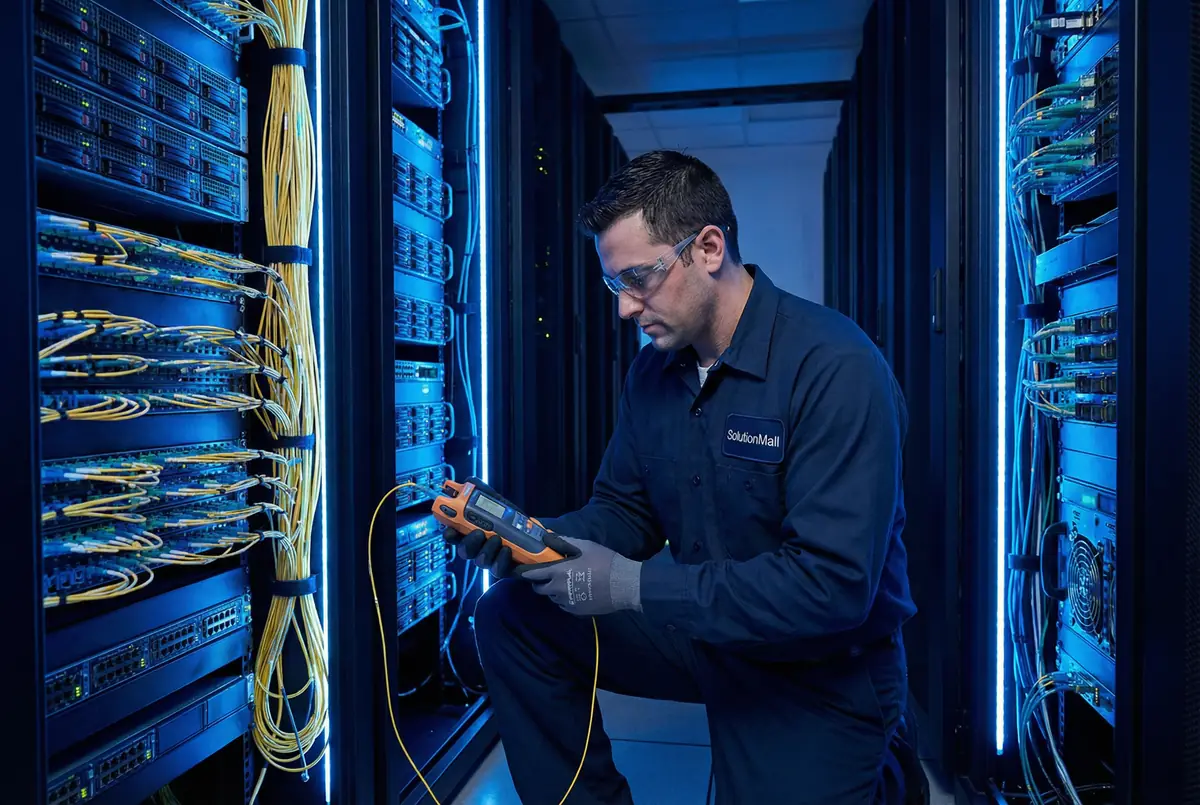
Complete fiber optic, cable testing, signal measurement and network verification tools for 5G base station deployment, data center cabling, and broadband infrastructure projects.

100Gbps
MAX BANDWIDTH
IEC 61300
KEY STANDARD
OTDR
KEY TEST
Telecom Engineering
📡

Signal Integrity & Network Reliability

📶
Signal Integrity
Precision OTDR and optical power meters ensure fiber link loss and reflectance meet ITU-T G.652 specifications, preventing signal degradation.
🌐
Network Reliability
Comprehensive cable certification tools verify Cat6A/Cat8 performance to TIA-568 standards, guaranteeing 10/25/100GbE network reliability.
🚀
Deployment Efficiency
Integrated fiber fusion splicers and visual fault locators reduce splice time by 40% and fault location time by 60%, accelerating project delivery.
🏗️

Telecom Network Testing Architecture

Physical Layer 📡 Fiber Optic Cable 🔌 Copper Cable 📻 Wireless RF Testing Layer 🔭 OTDR Tester 💡 Optical Power Meter 📋 Cable Certifier 📊 Spectrum Analyzer Verification Layer 🌐 Network Analyzer 📡 Signal Generator 📄 Test Report 🏆 Certification Signal Flow Test Path
🔩

Key Products in This Solution

📡
OTDR Fiber Tester
Dynamic Range: 42dB | Wavelength: 1310/1550nm | Distance: 250km
💡
Optical Power Meter
Range: -70 to +10dBm | Wavelength: 850-1625nm | Accuracy: ±0.2dB
✅
Cable Certifier
Cat6A/Cat8/Fiber | TIA-568/ISO 11801 | 2.5GHz Bandwidth
🔥
Fiber Fusion Splicer
Splice Loss: <0.02dB | Splice Time: 7s | Heating: 15s
🔦
Visual Fault Locator
Power: 1mW/10mW | Wavelength: 650nm | Range: 25km
📊
Spectrum Analyzer
Frequency: 9kHz-3GHz | Resolution: 1Hz | Dynamic: 100dB
🌐
Network Tester
10/100/1000M | PoE Test | VoIP/Video Quality
⚙️
Optical Attenuator
Range: 0-60dB | Step: 0.1dB | Wavelength: 1310/1550nm
🔍
Fiber Identifier
Live Fiber Detection | Bend-insensitive | Non-destructive
🔎
Cable Tracer
Tone Frequency: 1kHz/8kHz | Range: 3km | Inductive Probe
⚡
PoE Tester
IEEE 802.3af/at/bt | Max 90W | Voltage/Current Display
✂️
Fiber Cleaver
Cleave Angle: <0.5° | Blade Life: 48000 cleaves | Portable
🔄

Standard Operating Workflow

8-step standardized process from site survey to documentation

1
Site Survey
Route planning, fiber count, distance measurement
2
Cable Laying
Conduit installation, cable pulling, bend radius check
3
Fiber Splicing
Fusion splicing with OTDR verification of each splice
4
Connector Termination
Polish connectors, inspect end-face with microscope
5
Link Testing
OTDR trace, optical loss measurement, reflectance test
6
Copper Certification
Autotest with cable certifier to TIA/ISO standards
7
RF Verification
Spectrum scan, signal level, interference check
8
Documentation
Generate test reports, certification records, as-built drawings
📋

Applicable Standards & Certifications

Standard Scope Application Type
IEC 61300 Fiber optic interconnecting devices Fiber connectors, adapters Mandatory
ITU-T G.652 Single-mode optical fiber Fiber link performance Mandatory
TIA-568.3-D Optical fiber cabling Data center, enterprise LAN Mandatory
ISO/IEC 11801 Generic cabling for customer premises Structured cabling Recommended
IEEE 802.3 Ethernet standards 10/25/100GbE networks Mandatory
💡

Selection Recommendations

01

OTDR Wavelength Selection

For single-mode fiber, use 1310nm for short links (<20km) and 1550nm for long-haul. For multimode, use 850nm/1300nm. Always match OTDR wavelength to the operating wavelength of the system.

02

Cable Certifier Accuracy

For Cat6A certification, use Level IIIe or Level IV accuracy testers. Ensure test adapters match the connector type (RJ45/GG45). Calibrate adapters every 30 days or 500 tests.

03

Fusion Splicer Maintenance

Clean V-grooves and fiber clamps daily with IPA and lint-free wipes. Replace electrode rods every 3000 splices. Perform arc calibration before each session in new environments.

04

Spectrum Analyzer Setup

Set RBW to 1/100 of the span for accurate measurements. Use a pre-amplifier for signals below -80dBm. Always apply a 30dB attenuator when measuring unknown signal levels to protect the input.

Ready to Deploy Telecom Solutions?

Our telecom engineering specialists provide customized tool kits and technical support for 5G, fiber broadband, and data center projects.